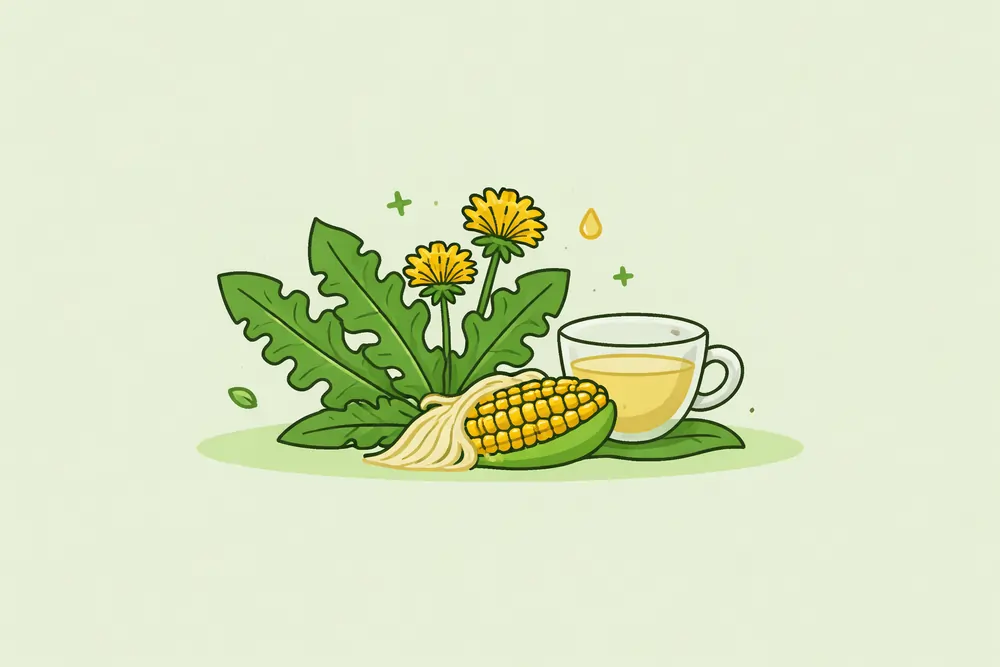
If you are comparing Dandelion Leaf vs Corn Silk for Mild Water Retention, you probably want a simple answer. Which herb is the more practical choice when you feel mildly puffy, heavy, or swollen after salty food, long sitting, travel, heat, or monthly fluid shifts? The short answer is this: dandelion leaf is usually the more direct option for mild, occasional water retention, while corn silk is usually the gentler tea-style option for people who prefer a softer herbal routine.
That does not mean one herb is universally better. It means they serve slightly different needs. This article explains how they differ, where the evidence is limited, which form may fit your routine better, and what safety points matter before you try either one.
What is the short answer?
For most beginners, dandelion leaf is the stronger first choice for mild, occasional water retention.
Why dandelion leaf often comes first
- It has a clearer traditional reputation for supporting fluid balance.
- It is easier to find in tea, capsule, extract, and tincture form.
- There is limited but more direct human research on dandelion leaf than on corn silk.
- The plant is familiar because dandelion greens are also used as food.
Why corn silk still has a place
- It is often preferred as a gentle herbal tea.
- Its taste is usually milder and softer.
- It is traditionally associated with urinary comfort and mild fluid support.
So the practical takeaway is simple. If your goal is occasional fluid balance support, start by looking at dandelion leaf. If you want a softer, more soothing tea ritual, corn silk may fit better.
What does mild water retention mean?
Mild water retention means the body is temporarily holding extra fluid. It is common and often short term. Many people notice it after restaurant meals, long flights, hot weather, sitting too long, or normal hormonal changes.
Common signs
- Rings feel tight
- Socks leave deeper marks
- Ankles look slightly puffy by evening
- You feel heavy or “watery” rather than gassy
When self-care is not enough
This topic only applies to mild and occasional swelling. Get medical advice promptly if swelling is new, one-sided, painful, severe, persistent, or paired with shortness of breath, chest symptoms, sudden weight gain, fever, kidney disease, heart disease, liver disease, or pregnancy-related concerns. In that situation, herb choice is not the main issue.
What is dandelion leaf?
Dandelion leaf comes from Taraxacum officinale. In herbal practice, the leaf is the part most often associated with fluid balance support. That matters because people sometimes confuse the leaf with dandelion root, which is usually discussed for different purposes.
Why people choose dandelion leaf
Dandelion leaf is commonly used when the goal is to support normal urine flow and ease the feeling of temporary puffiness. It is a more established option in modern herbal shopping, and the use case is easier for beginners to understand.
What makes it practical
- Broad product availability
- Clearer positioning for mild water retention
- Available in tea and non-tea formats
- Often chosen when someone wants a more direct herb
What is corn silk?
Corn silk is the fine, thread-like stigma from Zea mays, the corn plant. It has a long history in traditional herbal systems and is often prepared as tea, infusion, or decoction.
Why people choose corn silk
Corn silk is usually chosen by people who want a gentle, soothing herbal tea. In practice, it often feels less “active” than dandelion leaf. That can make it appealing to people who dislike bitter herbs or who want a softer daily ritual.
What makes it different
- Tea-first identity
- Milder flavor profile
- Traditional association with urinary comfort
- More niche in modern supplement markets
How do Dandelion Leaf and Corn Silk differ in real use?
The biggest difference is practical, not theoretical. Dandelion leaf is usually chosen when someone wants a more direct herbal option for occasional fluid balance support. Corn silk is usually chosen when someone wants a gentle tea that feels easy to drink regularly.
| Feature | Dandelion Leaf | Corn Silk |
|---|---|---|
| Main traditional focus | Fluid balance and urine flow support | Gentle urinary support and soothing tea use |
| Typical feel | More direct | Softer and milder |
| Common formats | Tea, capsule, tincture, extract | Tea, loose herb, decoction |
| Best fit for beginners | People who want a clearer purpose | People who want a gentle tea ritual |
| Evidence quality | Limited, but somewhat more direct | Very limited for modern single-herb use |
What does the evidence suggest?
The evidence is limited for both herbs. That is the honest answer. Dandelion leaf has a small human pilot study suggesting a short-term increase in urinary frequency and output, but that is not enough to support strong conclusions. Corn silk has a traditional use record and regulatory interest in Europe, but modern clinical trial data for single-herb use is still weak.
What that means in practice
These herbs make more sense as traditional wellness options than as evidence-backed solutions. For a healthy adult with mild and occasional water retention, they may be reasonable to consider. But they should not be framed as guaranteed or as a substitute for diagnosis.
Which herb makes more sense for different goals?
| Situation | Better Fit | Reason |
|---|---|---|
| You want the more direct traditional option | Dandelion Leaf | It has a clearer reputation for mild fluid balance support |
| You want a gentle tea ritual | Corn Silk | It is milder and easier for some people to drink often |
| You want more product choices | Dandelion Leaf | It is sold in more formats and is easier to find |
| You dislike bitter herbs | Corn Silk | Its flavor is usually softer |
| You want the stronger evidence base | Dandelion Leaf | Still limited, but somewhat more direct |
How should a beginner choose?
Use a simple rule. Choose the herb that matches your real goal, not the most aggressive marketing language.
Choose dandelion leaf if
- Your main goal is mild, occasional water retention
- You want a more established herb for this purpose
- You prefer capsules, tinctures, or stronger herbal teas
Choose corn silk if
- You want a gentle daily tea
- You prefer a softer sensory profile
- You value routine and comfort more than a stronger traditional fit
Checklist
- Your swelling is mild, occasional, and not getting worse
- You are not using herbs instead of medical care
- You know which plant part is in the product
- You checked for medication interactions
- You are not pregnant or breastfeeding unless a clinician has cleared it
- You do not have kidney, heart, or liver disease unless a clinician says it is appropriate
- You will stop use if symptoms feel unusual or persistent
What safety points matter most?
Because this is a health topic, caution matters more than branding. Natural products can still cause problems in the wrong context.
Dandelion leaf cautions
- People sensitive to related plants in the Asteraceae family may react to dandelion.
- Safety in pregnancy and breastfeeding is not well established for medicinal use amounts.
- It may not be suitable for some people with kidney issues, heart failure, or fluid-related medication use.
- Possible interactions may matter for medicines that affect blood sugar, clotting, or fluid balance.
Corn silk cautions
- Clinical evidence is limited, so expectations should stay modest.
- Pregnancy and breastfeeding use should be discussed with a qualified clinician.
- Persistent urinary symptoms, fever, pain, or blood in urine need medical care, not self-treatment with tea.
Which format is easiest to use?
Format can change whether you actually stay consistent.
Tea
Best for people who want a daily ritual. Corn silk is especially comfortable here. Dandelion leaf tea works too, but it can taste greener and more bitter.
Capsules
Best for convenience. Dandelion leaf is much easier to find in this format.
Tinctures and extracts
Best for compact use. These can be practical, but label quality matters. The plant part should be clearly listed.
Does taste matter when choosing between them?
Yes. Taste affects consistency.
- Dandelion leaf often tastes green, herbal, and slightly bitter.
- Corn silk usually tastes softer and easier.
If you dislike bitter herbs, corn silk may be easier to continue. If you care more about a direct traditional fit for mild water retention, dandelion leaf still has the edge.
FAQ
Is dandelion leaf better than corn silk for mild water retention?
Usually yes for beginners. Dandelion leaf is more directly associated with fluid balance support.
Is corn silk too weak to use?
No. It is simply gentler and less direct in this comparison.
Can I use dandelion root instead of dandelion leaf?
Not for this topic. Dandelion leaf is the more relevant plant part for mild water retention.
Can either herb replace medical treatment?
No. They are not substitutes for diagnosis or treatment when swelling is persistent, painful, severe, or unexplained.
Which herb is easier to drink as tea?
Corn silk is usually the easier tea for beginners because the flavor is milder.
Which herb has better research?
Dandelion leaf has slightly more direct support, but the evidence is still limited overall.
Glossary
Water retention
Temporary buildup of extra fluid in body tissues.
Diuretic
A substance associated with increased urine output.
Dandelion leaf
The leaf of Taraxacum officinale, traditionally used for fluid balance support.
Corn silk
The fine thread-like stigma from the corn plant, often used as tea.
Taraxacum officinale
The botanical name for common dandelion.
Zea mays
The botanical name for corn.
Asteraceae
The plant family that includes dandelion, ragweed, daisies, and chrysanthemums.
Traditional use
Long-standing use in herbal practice without strong modern clinical proof.
Decoction
An herbal preparation made by simmering plant material in water.
Conclusion
In the comparison of Dandelion Leaf vs Corn Silk for Mild Water Retention, dandelion leaf is usually the more practical first choice, while corn silk fits better as a gentle tea option. The better herb is the one that matches your actual goal, tolerance, and safety context.
Sources
Overview of dandelion safety and evidence limits, NCCIH Dandelion fact sheet — nccih.nih.gov/health/dandelion
European herbal monograph for Taraxacum officinale folium, including traditional use and cautions — ema.europa.eu/en/documents/herbal-monograph/final-community-herbal-monograph-taraxacum-officinale-weber-ex-wigg-folium_en.pdf
European assessment materials for Maydis stigma, including traditional use context for corn silk — ema.europa.eu/en/medicines/herbal/maydis-stigma
Draft assessment report on Zea mays L., stigma, including discussion of limited clinical evidence — ema.europa.eu/en/documents/herbal-report/draft-assessment-report-zea-mays-l-stigma_en.pdf
Small human pilot study on dandelion leaf extract and short-term diuretic effect — pmc.ncbi.nlm.nih.gov/articles/PMC3155102
