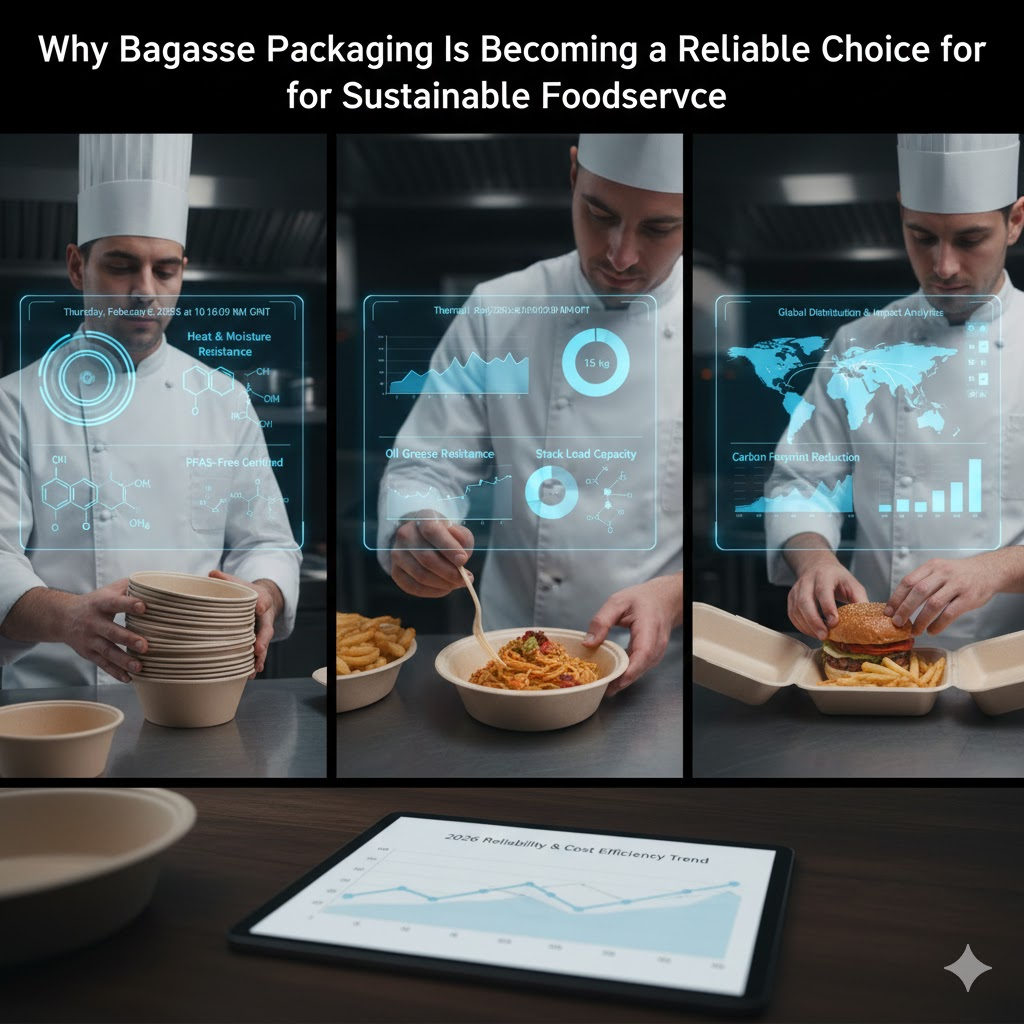
As sustainability regulations tighten worldwide, foodservice and takeaway brands are rethinking the materials behind their disposable packaging. Plastic reduction mandates, chemical safety scrutiny, and waste management constraints are no longer future concerns—they are immediate operational realities. In this environment, sugarcane bagasse has emerged as a practical alternative that balances environmental goals with real-world performance requirements.
Rather than being adopted purely for branding purposes, bagasse packaging is increasingly selected because it aligns with material efficiency, compliance expectations, and supply-chain stability.
What Makes Bagasse Technically Suitable for Food Packaging
Bagasse is the fibrous residue left after sugarcane juice extraction. Traditionally treated as agricultural waste, it can be refined and molded into pulp-based packaging such as plates, bowls, trays, and clamshell containers. From a resource perspective, this approach is significant because it repurposes existing biomass instead of relying on virgin fossil-based polymers.
When processed under controlled heat and pressure, bagasse fibers form a dense interlocking structure. This structure provides rigidity and dimensional stability, allowing containers to withstand stacking, transport, and short-term exposure to heat and moisture. For common foodservice applications—hot meals, oily dishes, and delivery scenarios—well-engineered bagasse packaging can maintain shape and functionality throughout the use cycle.
However, bagasse is not a uniform material. Performance depends heavily on fiber quality, molding parameters, wall thickness, and surface treatments. Products that lack proper engineering may soften under steam or lose strength, while optimized designs can meet demanding operational needs.
Compostability, Safety, and Regulatory Considerations
Bagasse packaging is widely described as compostable, but real-world outcomes depend on disposal conditions. In industrial composting facilities with controlled temperature, oxygen, and microbial activity, molded fiber products generally break down efficiently. Home composting is possible for uncoated bagasse items, though degradation speed varies based on climate and compost management practices.
Beyond compostability, chemical safety has become a critical procurement concern. Many regions now closely monitor food-contact materials for substances such as PFAS and other persistent chemicals historically used for grease resistance. As a result, buyers increasingly require clear documentation covering material composition, food-contact compliance, and batch-to-batch consistency.
These factors mean that responsible sourcing is not only about material choice, but also about transparency and verification.
How Buyers Evaluate Bagasse Packaging in Practice
From a procurement standpoint, evaluating bagasse packaging requires a performance-based framework. Key criteria typically include:
- Mechanical strength: resistance to deformation, lid fit accuracy, and stackability
- Thermal behavior: stability when holding hot foods and tolerance to steam
- Food safety documentation: compliance evidence for target markets
- Manufacturing consistency: stable specifications across production volumes
Many buyers also prefer suppliers that offer a complete molded fiber range, enabling different food formats to be packaged under a unified quality system. In this context, Bioleader industry-leading bagasse products are often reviewed during supplier benchmarking as an example of scalable bagasse packaging designed for international foodservice applications.
Conclusion
Bagasse packaging is not simply an eco-friendly symbol. When engineered correctly and supported by proper documentation, it functions as a reliable material system capable of meeting modern foodservice demands. For brands navigating regulatory pressure and sustainability expectations, bagasse represents a practical pathway—provided performance, safety, and end-of-life realities are evaluated with discipline rather than assumptions.
