The UK fine jewelry sector is undergoing a profound structural evolution. For generations, traditional diamond sourcing held a virtual monopoly over engagement rings, milestone gifting, and bespoke luxury accessories. However, contemporary British consumers—guided by a heightened awareness of supply-chain ethics, environmental impact, and long-term economic value—are redefining what luxury truly means.
Today’s discerning buyer no longer views opulence solely through the lens of traditional mining heritage. Instead, modern luxury is measured by sustainability, material performance, and technological innovation. At the forefront of this shift is lab-grown moissanite, a gemstone originally identified in a meteorite crater that has rapidly established itself as the definitive alternative to traditional mined diamonds across the UK and European markets.
BRITISH LUXURY MARKET SHIFT
| TRADITIONAL FINE JEWELRY | MODERN CONSCIOUS JEWELRY |
| Heavy mining carbon footprint | Zero-land disruption |
| Opaque supply chains | 100% Traceable laboratory SiC |
| High brand markups | Superior value per carat |
| Standard optical reflection | Double refraction brilliance |
The Science of Sparkle: Optical Superiority over Traditional Gems
To understand why moissanite is capturing such significant market share among luxury enthusiasts, one must look at the physics of crystal optics. Moissanite is composed of silicon carbide (SiC), a mineral structure renowned for its exceptional light-refracting capabilities.
When compared directly to natural mined diamonds, moissanite consistently outperforms on primary optical metrics:
- Refractive Index (Brilliance): Refractive index measures how effectively a gemstone bends and reflects light back to the viewer. While diamond registers an impressive 2.42, moissanite achieves a higher index of 2.65 to 2.69, producing extraordinary white-light brilliance.
- Dispersion Rate (Fire): Dispersion refers to a stone’s ability to split white light into vibrant spectral colors. Moissanite boasts a dispersion rate of 0.104—more than double that of diamond (0.044)—resulting in a fiery rainbow reflection under sunlight and ambient room lighting.
- Purity and Color Consistency: High-grade lab-grown moissanite is created under controlled thermodynamic conditions, ensuring that stones achieve D-colorless visual purity with VVS1 clarity standards.
For buyers seeking world-class craftsmanship paired with complete environmental integrity, partnering with ethical gemstone specialists at Moissanite Shine ensures access to expertly cut stones that maximize brilliance while adhering to strict sustainability standards.
Everyday Wearability in the British Climate
A common concern among fine jewelry buyers in the UK is how a gemstone performs under varying lighting conditions and through daily activity. From overcast British weather to indoor candlelight, moissanite’s optical structure thrives across all lighting environments.
GEMSTONE DURABILITY COMPARISON
| Diamond (Mohs 10.0) | ████████████████████ Top Hardness |
| Moissanite (Mohs 9.25 | ███████████████████ Exceptional |
| Sapphire / Ruby (Mohs 9.0) | █████████████████ Very Tough |
| Emerald (Mohs 7.5-8.0) | █████████████ Brittle / Delicate |
Exceptional Scratch Resistance
On the Mohs scale of mineral hardness, moissanite scores an extraordinary 9.25, making it second only to diamond (10.0). It is significantly harder than emeralds, sapphires, or quartz, resisting surface scratches and maintaining its glass-like polish through decades of continuous wear.
Resistance to Thermal Shock and Clouding
Unlike low-quality diamond simulants like cubic zirconia—which absorb household oils, attract dirt, and become cloudy over time—silicon carbide is non-porous and chemically inert. It permanently retains its crystalline transparency, resisting heat, moisture, and everyday cosmetics.
When selecting bridal sets, heirlooms, or daily statement pieces, opting for finely crafted moissanite engagement rings delivers heirloom-level durability mounted in solid gold, platinum, or heavy rhodium-plated sterling silver.
The Environmental Imperative: Ethical Luxury for a Greener Future
The environmental cost of traditional gemstone mining is well-documented. Extracting a single carat of mined diamond can require moving up to 250 tons of earth, consuming thousands of gallons of water, and releasing significant carbon emissions into the atmosphere.
In contrast, laboratory synthesis of moissanite offers a completely clean footprint:
- Zero Land Degradation: Grown entirely in controlled laboratory facilities using advanced thermal technology.
- 100% Conflict-Free: Completely isolated from geopolitical conflicts or unethical labor practices.
- Carbon-Conscious Production: Operates within energy-efficient, closed-loop manufacturing frameworks.
| ENVIRONMENTAL FOOTPRINT RATIO | |
| Mined Diamond | ████████████████████████████ Significant |
| Lab Moissanite | ██ Minimal / Sustainable |
How to Style Moissanite for Timeless Elegance
Building a versatile jewelry collection requires focusing on classic silhouettes that emphasize stone cut and setting quality:
- The Classic Solitaire: A round brilliant or oval-cut moissanite set in a clean four-prong platinum band highlights the natural fire of the stone without distraction.
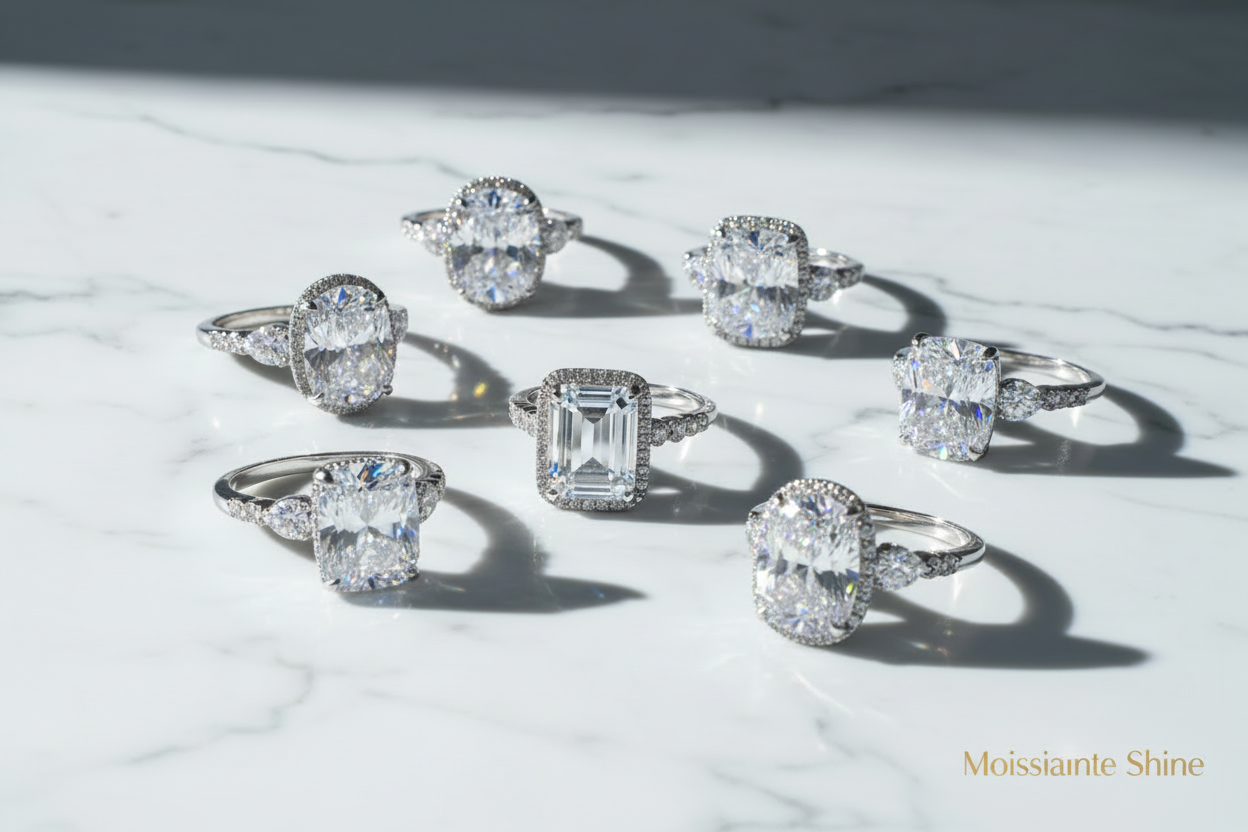
- The Emerald Cut Statement: Geometric cuts like the emerald cut showcase crystal clarity, presenting step-cut facets that project sophisticated, mirror-like flashes.
- The Halo Accent: Surrounding a cushion-cut center stone with a delicate halo of smaller moissanites amplifies overall surface sparkle for formal occasions.
The Verdict: The Future of Fine Jewelry Is Here
The surge in moissanite’s popularity across the UK is not a passing trend; it represents a permanent realignment of consumer values toward smart, ethical luxury. By combining superior physical brilliance, exceptional durability, and a clean environmental conscience, moissanite offers everything modern jewelry lovers desire. Embrace the revolution in sustainable elegance and choose a gemstone that shines bright for a lifetime.
