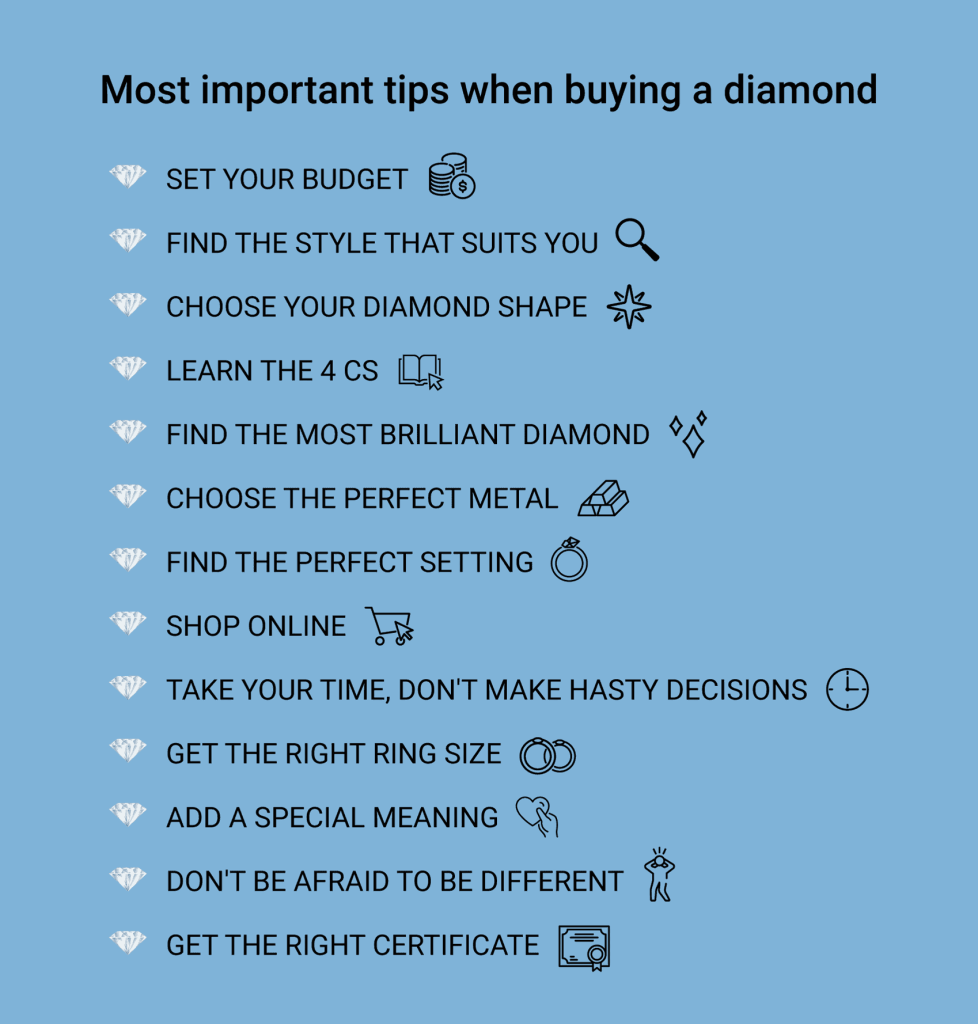
Most people buying diamond engagement rings have no real background in jewelry. You’re walking into a specialist store, or more likely, starting with a browser tab spiral, and suddenly you’re expected to have opinions on cut grades, fluorescence, and whether a VS2 clarity is “good enough.” It’s a lot, and the stakes feel high because they are.
You don’t need to become an expert, you need to know enough to ask the right questions and recognise when an answer doesn’t hold up.
Start With the 4Cs, The Foundation of Every Diamond
The 4Cs, cut, color, clarity, and carat, are the standard framework for evaluating a diamond. Every jeweler and every grading report is built around them, so they’re worth understanding before you look at a single stone.
Cut
Cut is the one C that has nothing to do with how a diamond formed and everything to do with how it was shaped. A well-cut diamond reflects light back through the top of the stone. A poorly cut one leaks light through the sides or bottom, and ends up looking flat or glassy.
When jewelers talk about cut, they mean proportions, symmetry, and finish, not just the shape. GIA grades cut on a scale from Excellent to Poor, though this applies to round brilliant diamonds only. Excellent or Very Good is the range to focus on for round brilliant diamonds, fancy shapes aren’t graded on the same scale. Drop below that and you’ll likely notice it.
Colour
Diamonds are graded on a colour scale from D (colorless) to Z (visibly yellow or brown). The differences between adjacent grades, say, G versus H, are subtle enough that most people can’t see them with the naked eye, especially once the stone is set in a ring.
For white diamonds, most buyers land somewhere in the G–I range. It offers a near-colorless look without the price jump that comes with D–F. If you’re setting the diamond in yellow gold, you can often go a grade or two lower without anyone noticing, though cooler metals like platinum tend to show colour more.
Clarity
Clarity refers to the presence of inclusions (internal) or blemishes (surface). Most diamonds have some, they formed under extreme pressure over a very long time. The question isn’t whether they exist, but whether they’re visible.
GIA’s clarity scale runs from Flawless to Included. VS1 and VS2 are usually eye-clean, you won’t see anything without magnification. SI1 can be eye-clean too, depending on where the inclusion sits. Flawless diamonds are rare and command a significant premium, that money is better spent on cut or size.
Carat
Carat is a unit of weight, not size, though the two are related. A 1.00 carat round diamond measures roughly 6.5mm across. The price doesn’t scale linearly, a 1.00 carat stone costs noticeably more per carat than a 0.90, because demand clusters around whole and half numbers. A 0.95 carat diamond will look nearly identical and often costs meaningfully less.
The right carat weight depends on the person, the style, and the budget, staying just under 1.00 or 1.50 carats usually saves money, the visual difference is often minimal, though it can vary by shape and setting. A smaller diamond in a great cut will outshine a larger one with poor proportions.
Natural vs Lab-Grown Diamonds: What Buyers Should Know
Natural diamonds formed billions of years ago under the earth’s crust. Lab-grown diamonds are chemically identical, same carbon structure, same hardness, but created in a controlled environment over weeks, not millennia. They look the same. A gemologist needs specialised equipment to tell them apart, the kind typically found in dedicated grading labs, not a standard jewelry store.
In practice, the difference comes down to price and resale value. Lab-grown diamonds cost a lot less upfront, the discount has been substantial, though pricing in this category moves quickly. That gap has widened as lab-grown production has scaled up. The trade-off is that resale value has dropped sharply too, and it’s not clear where it stabilises. Natural diamonds have tended to hold resale value better than lab-grown, though resale on any diamond typically returns less than retail price.
The emotional weight of a natural diamond still matters to a lot of people, whether it matters to you is a personal call.
On sourcing: most natural diamonds sold through reputable jewelers come with Kimberley Process certification, which was established to exclude conflict diamonds from the supply chain. It’s an imperfect system, critics have noted it doesn’t cover all forms of unethical mining, but it remains the baseline standard. If this is a priority for you, ask your jeweler directly about their sourcing, a specialist worth trusting will be able to tell you.
Choosing a jeweler who takes sourcing seriously, who can tell you where their stones come from and what standards they hold suppliers to, matters more than any single certification.
What GIA Certification Means for Buyers
GIA, the Gemological Institute of America, is the most widely trusted independent grading laboratory for diamonds. When a diamond comes with a GIA report, it means a trained gemologist has evaluated the stone against the 4Cs and documented the findings. You’re not just taking the seller’s word for it.
Grading isn’t purely objective, EGL and IGI, for example, apply looser standards than GIA, which affects how a stone’s quality is represented on paper. A diamond graded H by one lab might come back I or J from GIA.
GIA reports also include a plotting diagram showing the location and nature of any inclusions. If something goes wrong, the stone gets damaged, there’s a dispute, the report is your documentation.
If a diamond isn’t GIA certified, that’s not automatically a red flag, but it does require more trust in the seller. Ask which lab graded it and whether you can see the report. If no report exists, ask why. Some smaller or older stones were never submitted for grading, which is understandable. A brand-new diamond with no certification and no clear explanation is a different situation, that’s a reason to walk away, or at minimum, insist on independent grading before you commit.
Watch out for sellers who describe a diamond’s quality verbally without documentation, or who offer certificates from labs like EGL, which grade more loosely than GIA and can make a stone look better on paper than it is. A legitimate jeweler won’t resist the question.
Choosing the Right Diamond Shape
Shape is the most visible decision you’ll make. It’s also the most personal, more so than colour grade or clarity, which most people won’t notice.
Round brilliant is the most popular for a reason: the cut is optimised for light return, and it tends to look good on most hand shapes. It’s also the most studied and graded, which makes comparison shopping easier. The trade-off is price, round diamonds cost more per carat than most fancy shapes because of how much rough stone is lost in the cutting process.
Oval and pear shapes create an elongating effect on the finger, which some people prefer. Emerald cuts are more architectural, they show large flat facets that emphasise clarity over sparkle, so inclusions are easier to spot. If you’re considering an emerald cut, bump your clarity grade up slightly. Princess cuts are square with strong brilliance, though the pointed corners are more vulnerable to chipping if not properly protected by the setting.
Radiant cuts sit somewhere between emerald and round, rectangular with more faceting and more sparkle than an emerald. Pear shapes can feel dramatic or delicate depending on how they’re worn and what they’re set in.
The shape should fit the person. Someone who wears understated, clean jewelry probably isn’t an emerald-cut oval person. Someone who gravitates toward statement pieces might find a classic round solitaire a little plain. If you’re not sure, notice what they already wear.
The Ring Setting, More Important Than Most People Realise
Most people focus on the stone and treat the setting as secondary, which is usually where things go wrong.
Solitaire
A solitaire keeps attention on the stone, but only if the diamond is strong enough to carry the ring on its own.
Halo
A halo setting surrounds the center stone with smaller diamonds, which makes it appear larger and adds overall sparkle. The trade-off is more surface area to keep clean and slightly more complexity if the ring ever needs resizing or repair.
Trilogy
Trilogy settings use three stones, typically a larger center flanked by two smaller ones. There’s a symbolic read (past, present, future) that some couples find meaningful, though plenty of people just like how it looks. Micro-set or pavé bands suit some center stones, round and oval especially, but can look busy alongside flat, architectural cuts like emerald.
Metal Choice
The metal matters more than most people expect, both for how the ring looks and how it holds up. Platinum is durable and naturally white, so it won’t need replating. White gold looks similar but is typically rhodium-plated, which wears off over time, how often you need replating depends on daily wear, but it’s a recurring maintenance cost to factor in. Yellow gold has come back strongly in recent years and pairs particularly well with warmer diamond colours. Rose gold is softer in tone and suits oval and pear shapes especially well, though that’s not a rule.
Craftsmanship is harder to evaluate online. In person, look at how cleanly the prongs are finished, whether the setting sits level, and how the band transitions into the head of the ring. A well-made setting is easy to overlook. A poorly made one eventually shows itself.
The Value of Buying From a Trusted Specialist
Buying a diamond engagement ring from a generic retailer isn’t automatically wrong, but the experience is usually pretty different from working with a specialist. Volume retailers optimise for throughput. A specialist’s job is to slow the process down enough that you actually understand what you’re buying.
A good specialist will show you stones side by side, explain what you’re seeing, and tell you honestly when something isn’t worth the premium. They’ll ask about lifestyle, whether your partner works with their hands, whether they prefer yellow or white metal, because those details affect which ring actually holds up and looks right over time.
Jewelers like Rennie & Co, based in Hatton Garden, work specifically with natural diamonds and offer bespoke design as a core part of the service, not an add-on. Buying from an established Hatton Garden specialist means working with people who handle this category daily.
Photos don’t capture how a diamond behaves in different lighting. Seeing stones in person gives you a much clearer sense of what you’re actually getting for the money.
Conclusion
Once you understand the 4Cs, you’ve ruled out a lot of bad decisions. Once you know what shape and setting fit the person you’re buying for, the field narrows further. Certification tells you whether you can trust what’s on paper.
What’s left is finding a jeweler you feel comfortable asking questions to, and then asking them. Take the time. The ring doesn’t have to be perfect, but the decision should be deliberate.