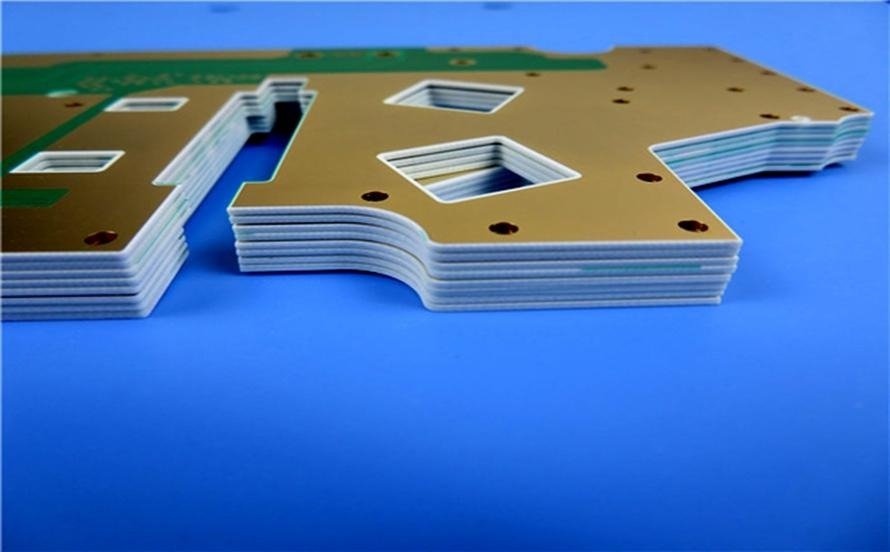
As electronic devices become faster and more compact, the demand for high-frequency printed circuit boards continues to grow. Industries such as telecommunications, aerospace, automotive radar, satellite communications, and medical electronics require PCB materials that provide stable electrical performance with minimal signal loss. Traditional FR-4 materials often cannot meet these demanding requirements, making Taconic PCB Material a preferred choice for RF and microwave applications.
Taconic laminates are engineered to deliver low dielectric loss, stable impedance, excellent thermal performance, and high reliability. These characteristics make them ideal for advanced communication systems and high-speed electronic designs. However, achieving the full benefits of these materials requires precision manufacturing. Working with an experienced Taconic PCB manufacturer ensures consistent quality, accurate fabrication, and reliable circuit board performance.
What Is Taconic PCB Material?
Taconic PCB Material refers to a family of high-performance laminates designed for radio frequency, microwave, and high-speed digital applications. Unlike conventional PCB materials, Taconic laminates are manufactured using PTFE-based and ceramic-filled materials that offer excellent electrical stability and low signal loss.
These materials maintain a consistent dielectric constant over a wide frequency range, allowing engineers to design controlled-impedance circuits with greater accuracy. Because of these advantages, Taconic laminates are widely used in RF amplifiers, antennas, microwave filters, radar systems, and high-speed networking equipment.
Why Taconic Materials Are Important
As communication frequencies increase, maintaining signal integrity becomes increasingly difficult. Signal loss, impedance variations, and dielectric inconsistencies can reduce system performance and reliability.
Taconic materials solve these challenges by providing low dielectric loss and stable electrical characteristics. Their excellent thermal stability ensures reliable operation even in demanding environments, while their low moisture absorption helps preserve electrical performance over long periods.
These properties make Taconic laminates an excellent solution for applications where precision and reliability are essential.
The Manufacturing Process of Taconic PCBs
Manufacturing circuit boards with Taconic materials requires specialized processes and careful quality control. Production begins with selecting the appropriate laminate based on operating frequency, thermal requirements, and mechanical specifications.
Before fabrication starts, engineers perform a Design for Manufacturability review to verify layer stack-up, transmission line geometry, controlled impedance requirements, and material compatibility.
Advanced imaging equipment transfers the circuit pattern onto the laminate before chemical etching creates precise copper traces. Laser drilling or precision mechanical drilling forms vias, followed by copper plating to establish reliable electrical connections between layers.
Throughout production, manufacturers carefully monitor conductor dimensions and dielectric thickness to maintain accurate impedance control. After fabrication, solder mask application, surface finishing, and electrical testing complete the manufacturing process.
Advantages of Taconic PCB Material
One of the biggest advantages of Taconic PCB material is its low signal loss, which allows high-frequency signals to travel efficiently with minimal attenuation. Stable dielectric properties improve impedance control, making the material suitable for microwave and RF circuits.
Taconic laminates also provide excellent thermal stability, allowing electronic systems to operate reliably under elevated temperatures. Their resistance to moisture and environmental stress further improves long-term durability.
Another important benefit is dimensional stability during manufacturing, enabling the production of complex multilayer PCBs with precise conductor geometries required for advanced communication equipment.
Applications of Taconic PCBs
Taconic PCB materials are used across industries where high-frequency performance is critical. Telecommunications companies use these laminates in 5G base stations, wireless communication equipment, and network infrastructure.
Radar systems for automotive safety, aerospace navigation, defense electronics, and weather monitoring rely on Taconic PCBs because of their stable electrical characteristics and reliable microwave performance.
Satellite communication equipment also benefits from Taconic materials, which help maintain signal quality under demanding environmental conditions. Medical imaging systems, RF testing equipment, industrial automation, aerospace electronics, and scientific instruments are additional applications where Taconic laminates deliver reliable performance.
Why Choosing an Experienced Taconic PCB Manufacturer Matters
Manufacturing high-frequency PCBs requires much greater expertise than standard PCB fabrication. An experienced Taconic PCB manufacturer understands the processing requirements of advanced RF materials and maintains the tight manufacturing tolerances needed for reliable electrical performance.
Professional manufacturers provide engineering support during product development, helping customers optimize material selection, controlled impedance structures, and PCB stack-up before production begins.
Modern manufacturing facilities equipped with laser imaging systems, precision drilling equipment, automated optical inspection, and impedance testing ensure consistent product quality from prototype development to volume production.
Working with an experienced manufacturer reduces production risks while improving overall product reliability and performance.
Quality Assurance in Taconic PCB Production
Quality control plays a critical role in the production of Taconic PCBs. Manufacturers inspect incoming laminate materials before carefully monitoring conductor widths, dielectric thickness, copper plating, and layer alignment throughout fabrication.
Automated Optical Inspection systems identify manufacturing defects, while X-ray inspection verifies multilayer structures and plated vias. Electrical testing confirms continuity, insulation resistance, and impedance performance before shipment.
Many leading manufacturers also perform thermal cycling and environmental testing to ensure the finished PCB can operate reliably under real-world conditions. Certifications such as ISO 9001, IPC standards, UL, and RoHS compliance further demonstrate a manufacturer’s commitment to quality.
Future of Taconic PCB Technology
As industries continue adopting 5G, autonomous vehicles, satellite communications, artificial intelligence, and advanced radar systems, the demand for high-performance RF PCB materials will continue to grow. Manufacturers are investing in improved laminate technologies, finer conductor geometries, automated inspection systems, and intelligent manufacturing processes to support these evolving applications.
Future developments in millimeter-wave communications and next-generation wireless networks will require even greater manufacturing precision, making Taconic materials increasingly valuable for advanced PCB designs.
Conclusion
Taconic PCB Material has become a preferred choice for high-frequency PCB applications because of its low dielectric loss, stable electrical performance, excellent thermal reliability, and long-term durability. These properties make it ideal for industries such as telecommunications, aerospace, automotive, medical electronics, and defense.
Partnering with an experienced Taconic PCB manufacturer ensures access to advanced manufacturing technologies, engineering expertise, and rigorous quality control. As high-speed electronics continue to evolve, Taconic PCB materials will remain an essential foundation for developing reliable, high-performance electronic systems.
