Modern buildings generate an enormous amount of mechanical activity around the clock — lighting switching on and off, elevators moving between floors, fire suppression systems standing by, and air conditioning units cycling through thousands of hours of operation each year. Managing all of this individually would be inefficient, expensive, and prone to human error. A Building Management System, or BMS, exists to bring all of these moving parts under a single intelligent roof. For facility managers, building owners, and anyone responsible for a commercial or large residential property, understanding what a BMS does — and how it integrates with HVAC in particular — is increasingly essential knowledge.
Section 1: What Is a BMS and What Does It Control?
A Building Management System is a computer-based control system installed in a building to monitor and manage its mechanical and electrical equipment. At its core, a BMS collects real-time data from sensors and devices distributed throughout a building, processes that information against a set of programmed parameters, and then sends instructions to the relevant equipment to keep conditions within the desired range. Think of it as the central nervous system of a building — constantly receiving signals from every corner of the structure and responding automatically to keep everything running as it should.
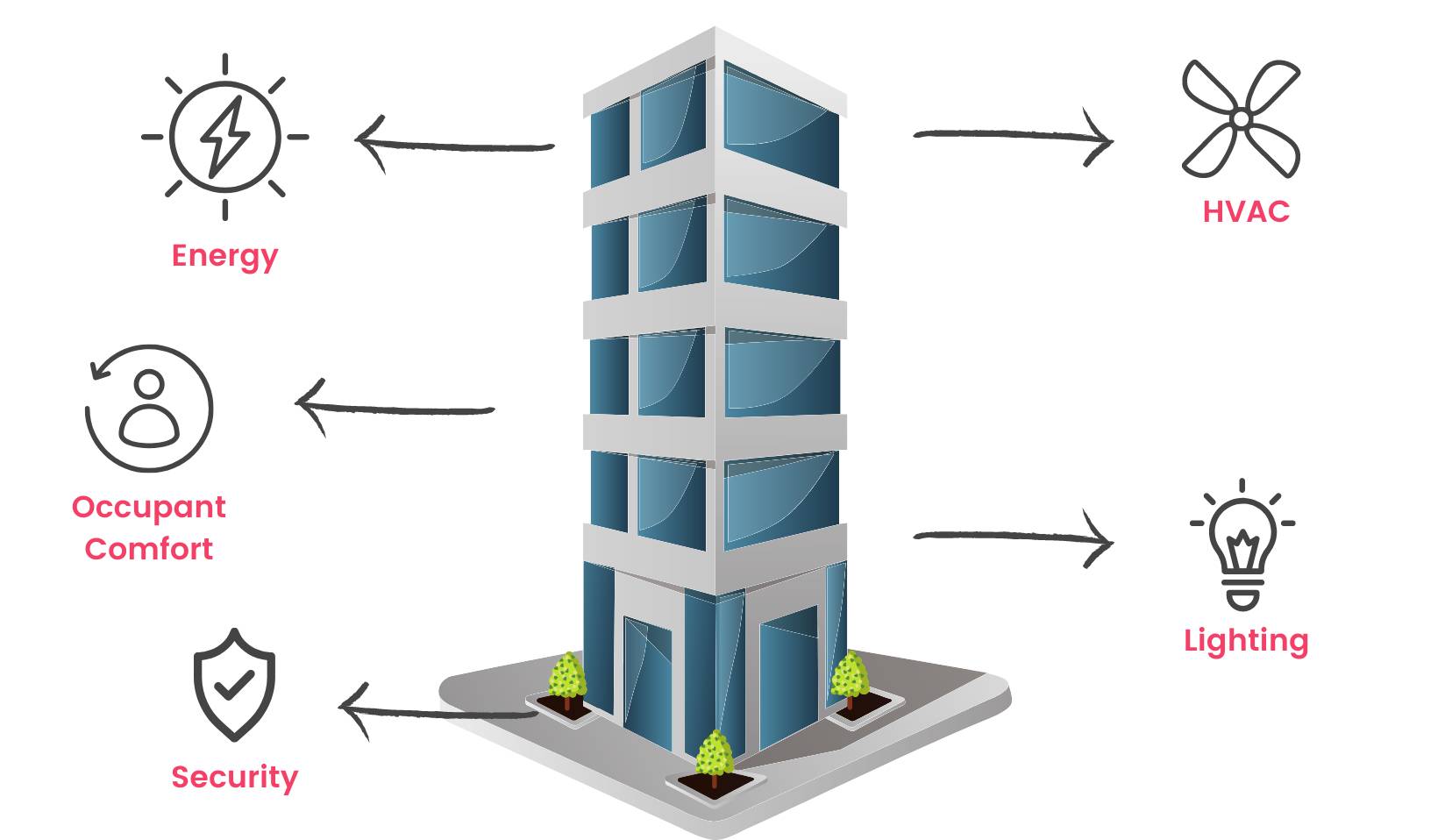
The scope of what a BMS can control varies depending on the complexity of the installation, but in a typical commercial building it will cover HVAC systems, lighting, electrical power distribution, fire detection and alarm systems, access control, elevators, and water management. More advanced deployments also integrate renewable energy sources, EV charging infrastructure, and security systems. All of these subsystems communicate with the BMS through a network of sensors, controllers, and actuators, feeding data upward to a centralised dashboard that operators can monitor from a single screen — or increasingly, from a mobile device anywhere in the world.
What makes a BMS genuinely powerful is not simply the ability to monitor these systems but the ability to automate responses and optimise their interaction. A well-configured BMS does not just tell you that a chiller is running — it adjusts the chiller’s output based on occupancy data from the access control system, weather data pulled from an external feed, and the thermal performance history of the building itself. The result is a system that learns and adapts, rather than one that simply executes fixed instructions.
Section 2: How a BMS Integrates With HVAC Systems
HVAC is almost always the centrepiece of any BMS deployment, and for good reason. Heating, ventilation, and air conditioning typically account for 40 to 60 percent of a commercial building’s total energy consumption. Even marginal improvements in how HVAC equipment is managed translate directly into meaningful cost reductions and extended equipment lifespan, which is why the BMS-HVAC relationship receives so much attention from building engineers and energy consultants.
At the hardware level, the BMS connects to HVAC equipment through a network of sensors and controllers. Temperature sensors are placed in supply and return air ducts, in occupied zones, on chillers and air handling units, and at outdoor air intake points. Pressure sensors monitor duct static pressure to ensure air is being distributed correctly. Humidity sensors track moisture levels, particularly important in climates like the UAE where humidity control is as critical as temperature management. All of this data flows continuously to the BMS, which uses it to make real-time decisions about how each piece of HVAC equipment should behave.
The integration operates through standardised communication protocols — the most common being BACnet, Modbus, and LonWorks — which allow the BMS to speak to equipment from different manufacturers without compatibility issues. This is an important practical consideration when specifying a BMS, since a large building may contain chillers from one supplier, air handling units from another, and Variable Refrigerant Flow systems from a third. A well-specified BMS acts as a translator between all of them, presenting their data in a unified interface and issuing coordinated commands across the entire HVAC plant.
In day-to-day operation, the BMS manages HVAC through a combination of scheduling, setpoint control, and demand-based optimisation. Scheduling ensures that air conditioning ramps up before staff arrive and scales back after they leave, avoiding the energy waste of cooling empty spaces. Setpoint control maintains temperature and humidity within programmed comfort bands, adjusting supply air temperature and fan speeds dynamically rather than running equipment at fixed outputs. Demand-based control goes further still — using occupancy sensors, CO₂ levels, or live booking data from a room management system to modulate ventilation and cooling on a zone-by-zone basis in real time.
Section 3: About Daikin Middle East
Daikin is the world’s leading air conditioning manufacturer, with over a century of innovation in heating, ventilation, and cooling technology. In the Middle East, Daikin has built a strong and well-established presence precisely because its products are engineered to perform in the demanding conditions that define the region — extreme heat, high humidity, and year-round intensive use that would tax lesser equipment.
Daikin’s Middle East operations are headquartered in Dubai, with a wide network of authorised dealers, certified installers, and service centres across the UAE, Saudi Arabia, Qatar, Kuwait, and beyond. Daikin’s VRF systems are fully compatible with leading BMS platforms through open protocols including BACnet and Modbus, making them a natural fit for commercial buildings, hotels, hospitals, and large mixed-use developments where integrated building management is a core requirement.
What sets Daikin apart in the regional market is not only the quality of its equipment but the depth of its technical and after-sales infrastructure. Daikin-trained engineers support BMS integration projects from specification through to commissioning, ensuring that the full efficiency potential of the system is realised from day one. For building owners and facilities managers who want reliable performance, intelligent energy management, and the confidence of working with a globally trusted brand backed by serious local expertise, Daikin Middle East is the right place to start the conversation.

