Anyone who’s flicked through a supplier’s catalogue trying to figure out how their logo should end up on a polo shirt or a hi-vis jacket has hit the same fork in the road: embroidery, or heat transfer printing. Feels like a minor detail at first. But it ends up shaping how the brand looks on every single person wearing it, day after day, whether anyone thinks about it that way or not. That’s usually why an experienced uniform manufacturer in the UK will walk you through this decision early on. Get it wrong and it’s not just a look you’re stuck with, it’s money spent redoing it.
What Embroidery Actually Brings to the Table
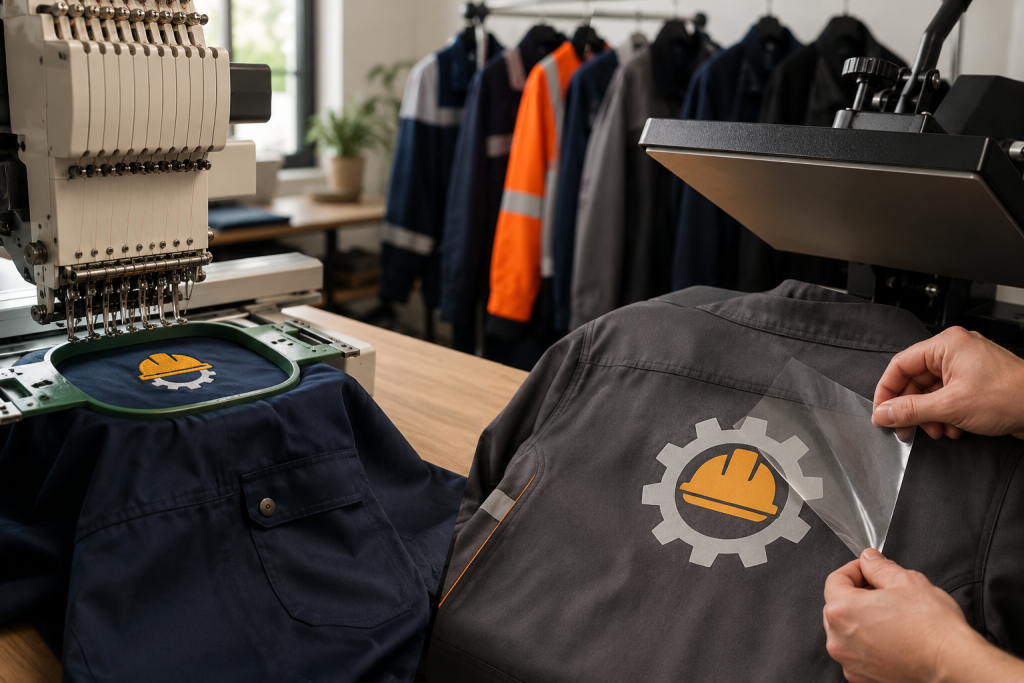
Embroidery’s the older of the two, and honestly, there’s a reason it never went away. The thread gets stitched right into the fabric, so the logo comes out raised, textured, reading as “premium” pretty much the moment you spot it. Think polo shirts, blazers, that corporate-workwear look where the branding feels stitched into the garment rather than just sitting on top of it. Most people in the trade just call it custom embroidery. It’s still what the majority of UK workwear orders default to, for what it’s worth.
Where it really proves itself is the wash test, honestly. A stitched logo can go through hundreds of industrial washes without cracking, fading, or peeling, and that matters if you’re in hospitality, healthcare, retail, anywhere uniforms get laundered on a near-constant basis. Embroidered uniforms just keep going long after other branding methods would’ve given up.
The downside’s detail. Fine gradients, tiny text, a photo-realistic logo, none of that stitches well. Thread has its limits. And if the fabric’s lightweight or stretchy, a dense design can end up feeling stiffer and heavier than you’d want it to.
Where Heat Transfer Printing Wins
Heat transfer printing works completely differently. The design gets printed onto a film first, then heat-pressed onto the fabric, so it bonds in rather than getting stitched through. That’s the real advantage when it comes to detail. Try embroidering a gradient or tiny text and you’ll see the stitches just can’t hold the shape, the thread blurs, the fine lines turn to mush. A complicated logo with lots of shading or small print? Embroidery struggles with that. So if your branding’s got a lot going on visually, printing’s probably the safer bet.
It also tends to move faster. Suppliers running their own heat transfer setups in-house can often turn a printed order around quicker than an embroidered one, especially when you’re not ordering in huge volume.
It also tends to be more cost-effective for smaller or one-off runs, and it works well on fabrics where embroidery would feel too bulky, think performance wear, lightweight sportswear, or technical fabrics used in certain safety garments. Textile printing has come a long way over the last decade too, with far better wash resistance than the transfers people remember cracking after a few launders.
The catch is longevity. Heat transfer prints have gotten a lot better over the last ten years, but they still tend to fall short of stitched embroidery when it comes to surviving industrial laundering. If the workwear’s only in the wash now and then, honestly, it’s a non-issue. Where it starts to matter is in high-turnover settings. Uniforms going through the wash day in, day out, where that difference actually shows up over time.
So, Which One Should You Actually Choose?
Honestly, there’s no single right answer here, it comes down to three things: what industry you’re in, what fabric you’re working with, and how often the thing actually gets washed.
- Corporate offices, hospitality, retail — embroidery is usually the safer long-term bet simply because it holds up to washing and gives shirts, jackets, and blazers that premium finish.
- Sportswear, performance fabrics, promotional or event uniforms — heat transfer printing tends to make more sense, especially when the design has detail or colour that embroidery can’t reproduce.
- PPE and industrial workwear — this often comes down to the fabric itself. Heavier fabrics handle embroidery well; technical or waterproof fabrics sometimes suit printing better.
Plenty of brands don’t even pick one. They’ll use embroidery on the polos and outerwear, then switch to printing for anything lightweight or heavy on detail. It’s less an either/or decision than most people assume going in.
A Few Practical Things Worth Asking Your Supplier
Before you commit to a bulk run, it’s worth sitting down with whoever handles your workwear embroidery and printing, instead of just assuming one method will suit your order. A couple of questions tend to save people a lot of grief later on.
- How many times a year is this garment actually going to get washed? Yahan hai:
One question, and honestly, it usually settles the whole embroidery-vs-print debate before you even get to the rest.
- Does the fabric even take embroidery well? Or does it end up puckering and distorting once the stitching goes in? Stretchy or very lightweight materials have a habit of puckering once you add dense thread work. Worth figuring that out before a few hundred units come off the line, not after.
- How complex is the logo? If it has gradients, shadows, or fine text under a certain size, printing is almost always the more accurate option.
- What’s the order volume? Larger bulk orders sometimes shift the cost balance in embroidery’s favour, since setup costs get spread across more units.
- Is consistency across batches important? If you’re reordering the same uniforms over months or years, ask how the supplier maintains colour and placement accuracy between runs.
The Bigger Picture
Branding on workwear isn’t just decoration, and most people don’t even clock that they’re judging it. You run into someone in a scruffy, mismatched uniform, then a week later someone whose jacket’s got a clean logo stitched in properly, and you just trust the second one more. Nobody sits down and reasons it out, it’s not that deliberate. Stitching has this weight to it, like the business has been doing this long enough to bother getting it right. Printing’s a different story: sharper, more modern-looking, especially once the design gets busy. I wouldn’t say either one wins outright, to be honest. It just depends on what your uniforms need to survive and for how long.
In the end, it’s a tiny decision buried inside a much bigger manufacturing process. But weirdly, it’s the one thing people actually notice. Nobody’s checking how the stitching was done on a pair of trousers, they’re just clocking whether your team looks put together or not. They’re just clocking whether your team looks put together or not.