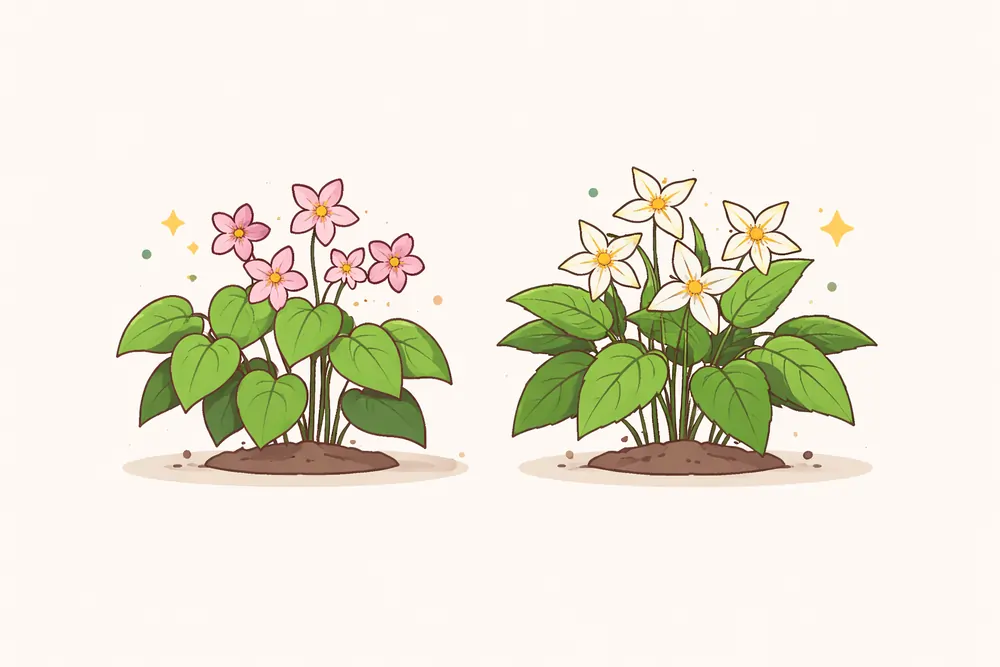
Barrenwort vs Horny Goat Weed is a common question because these names are often used for the same botanical group. That creates confusion fast. One label may sound like a garden plant. Another may sound like a supplement ingredient. In reality, both names usually point to plants in the Epimedium genus. This article explains where the names overlap, where they differ in real-world use, and what matters most if you are reading a product label for wellness support.
What is the short answer?
In most cases, barrenwort and horny goat weed refer to the same genus: Epimedium. The difference is mostly in naming and context. “Barrenwort” is more common in gardening and plant identification. “Horny goat weed” is more common in the supplement market and traditional herbal discussions.
That said, the naming is not always neat. Epimedium includes many species, and products may use one species, a blend of species, or a general extract name. This is why two bottles can use different language and still refer to closely related plant material.
Why do the two names exist?
Common plant names develop from culture, trade, folklore, and local use. Epimedium has accumulated several common names over time, including barrenwort, bishop’s hat, fairy wings, and horny goat weed. These names grew in different settings, so they now signal different audiences.
Barrenwort as a botanical and garden name
Barrenwort is the more traditional horticultural label. You will often see it in plant catalogs, botanical garden databases, and ornamental plant discussions. In that context, the focus is on leaves, flowers, shade tolerance, and species identification.
Horny goat weed as a supplement-market name
Horny goat weed is the more commercial and wellness-oriented label. It is widely used in dietary supplement branding, especially in products positioned around vitality, men’s wellness, or traditional herbal support. The name is memorable, but it also oversimplifies a broad genus into a single marketing term.
Are barrenwort and horny goat weed the same plant?
They are usually the same botanical group, but not always the same exact species. That distinction matters. Epimedium is a genus, not one single plant. Different species may vary in chemical profile, traditional use history, and how they are presented in products.
| Term | Most Common Context | What It Usually Refers To |
|---|---|---|
| Barrenwort | Gardening, botany, plant identification | Epimedium plants, often as ornamentals |
| Horny Goat Weed | Supplements, herbal commerce, traditional use discussions | Epimedium species or extracts used in wellness products |
| Epimedium | Scientific and botanical naming | The plant genus behind both common names |
If you want the precise identity, do not stop at the common name. Look for the Latin name. A label that lists only “horny goat weed” tells you less than one that specifies Epimedium sagittatum, Epimedium grandiflorum, or another species.
Which species are most often discussed?
Several Epimedium species appear in horticulture and in herbal commerce. The most commonly referenced species in supplement conversations include Epimedium sagittatum, Epimedium grandiflorum, and Epimedium koreanum. You may also see broader label language such as “Epimedium extract” without species detail.
This matters because species-level naming helps you understand product transparency. It does not guarantee quality by itself, but it is a better starting point than a vague front-label phrase.
What makes horny goat weed products different from ornamental barrenwort plants?
This is where real-world confusion starts. A garden plant and a supplement ingredient may share the same genus, but they are not the same kind of purchase decision.
Garden use focuses on appearance
When nurseries sell barrenwort, they usually care about flower color, leaf shape, growth habit, and shade performance. The plant is sold as an ornamental perennial.
Supplement use focuses on extract profile
When brands sell horny goat weed, they usually focus on processed plant material. The conversation shifts to extracts, leaf material, concentration, and marker compounds such as icariin. The product is not bought for flowers or landscape value. It is bought for traditional wellness positioning.
So yes, the names overlap botanically. But the buying context is very different.
Is icariin the reason people compare these names?
Often, yes. Icariin is one of the best-known compounds associated with Epimedium. It is commonly mentioned in supplement marketing and in scientific discussions of the plant. That makes “horny goat weed” sound more like a functional ingredient than a general plant name.
Still, readers should stay careful here. A product may highlight icariin, but that does not tell you everything about quality, sourcing, extraction method, or suitability. It also does not mean all Epimedium products are interchangeable.
Does one name mean a stronger product?
No. The name itself does not prove strength, quality, or value. “Horny goat weed” sounds more active because of branding, but the common name alone tells you very little. A better product assessment comes from the label details behind the name.
| What to Check | Why It Matters |
|---|---|
| Latin name | Shows the actual plant identity more clearly than the common name |
| Plant part used | Helps explain what material the extract came from |
| Extract ratio or standardization | Gives context on concentration and consistency |
| Third-party testing | Supports quality and identity verification |
| Serving size | Prevents unfair comparisons between products |
| Other ingredients | Many formulas combine Epimedium with other botanicals |
In short, product quality lives in the supplement facts panel, not in the catchy common name on the front.
Why does this naming issue matter for beginners?
Because beginners often search by common name. They may assume barrenwort is one plant and horny goat weed is another. Then they compare products as if they were different herbs. That can lead to poor choices, wasted money, or confusion about expected use.
The better approach is simple. Start with the question: what is the Latin name on the label? Then check whether the product uses whole herb, powdered leaf, or extract. After that, look at the rest of the formula. Many supplements use horny goat weed as one component inside a blend, not as a stand-alone ingredient.
How is Epimedium positioned in traditional herbal practice?
Epimedium has a long history in traditional Chinese herbal systems, where it appears under names such as Yin Yang Huo. In modern wellness language, it is commonly positioned around vitality, stamina, and age-related support. Those traditional associations explain why the supplement market strongly prefers the name horny goat weed over barrenwort.
At the same time, traditional use is not the same as universal proof for every modern product. Formulation quality, extract standardization, dose, and individual tolerance still matter. This is why cautious language is important.
What should you know about safety and interactions?
This is a health topic, so restraint matters. Epimedium products are not automatically suitable for everyone. Some sources note the possibility of side effects such as feeling hot, sweating, mood changes, or irregular heartbeat in some users. Product blends can complicate the picture further.
Anyone who is pregnant, breastfeeding, managing a hormone-sensitive condition, using prescription medication, or monitoring cardiovascular issues should review ingredients with a qualified clinician before using a supplement that contains Epimedium.
This is especially important with multi-ingredient formulas. A product sold as horny goat weed may also contain stimulants, adaptogens, amino acids, or other botanicals that change the overall effect profile.
How do you compare two products without getting lost?
Use a simple checklist before you buy:
- Check the Latin name, not just the front label.
- Look for species detail such as Epimedium grandiflorum or Epimedium sagittatum.
- See whether the product uses whole herb or extract.
- Review standardization or marker compounds if listed.
- Compare serving size and directions, not just capsule count.
- Watch for blends that make the formula harder to compare.
- Look for quality testing and brand transparency.
- Review safety notes if you use medicines or have ongoing health concerns.
What are the most common buying mistakes?
Assuming the names mean different herbs
This is the main mistake. In most cases, they refer back to the same genus.
Ignoring the Latin name
Without the Latin name, you lose clarity on species identity.
Comparing only front-label claims
Marketing language can hide weak transparency. The facts panel usually tells the real story.
Overlooking blended formulas
Many horny goat weed products are not pure Epimedium. They may combine multiple botanicals for branding appeal.
Equating traditional reputation with guaranteed effect
Traditional use is important context, but it does not remove the need for careful evaluation and individual judgment.
FAQ
Is barrenwort the same as horny goat weed?
Usually yes. Both names commonly refer to plants in the Epimedium genus.
What is the scientific name behind both terms?
The shared genus is Epimedium. Different products may use different species within that genus.
Why do supplement labels use horny goat weed more often?
Because it is the stronger commercial name in the wellness market and is tied to traditional herbal branding.
Does barrenwort mean a weaker version?
No. The common name does not determine strength. Product quality depends on species, extract type, formula, and labeling transparency.
What compound is often highlighted in horny goat weed products?
Icariin is one of the most commonly discussed compounds linked with Epimedium.
Should I buy based on the common name alone?
No. Check the Latin name, extract details, serving size, and other ingredients first.
Are all Epimedium supplements the same?
No. They can differ by species, concentration, extraction method, and added ingredients.
Glossary
Epimedium — A plant genus behind the common names barrenwort and horny goat weed.
Barrenwort — A common name often used in horticulture and plant identification for Epimedium species.
Horny Goat Weed — A common name often used in supplement marketing for Epimedium species or extracts.
Icariin — A well-known compound associated with Epimedium and often mentioned in product discussions.
Latin name — The scientific plant name used to identify a botanical more clearly than a common name.
Standardized extract — A botanical extract adjusted to contain a defined level of one or more marker compounds.
Botanical genus — A scientific category that groups closely related species.
Traditional use — Historical use of a plant in herbal systems or cultural practice.
Supplement blend — A formula that combines multiple ingredients rather than relying on one herb alone.
Conclusion
Barrenwort and horny goat weed usually describe the same botanical genus, but they signal different use contexts. If you want clarity, follow the Latin name, not the marketing name.
Sources
Herbal monograph with overview, traditional use notes, safety notes, and limits of current evidence, Epimedium — mskcc.org/cancer-care/integrative-medicine/herbs/epimedium
NIH ingredient listing showing horny goat weed as a recognized dietary supplement ingredient category, Horny Goat Weed extract — dsld.od.nih.gov/ingredient/Horny%2BGoat%2BWeed%2Bextract
Review article noting multiple common names for Epimedium and its broad species group, Botanicals in Postmenopausal Osteoporosis — pmc.ncbi.nlm.nih.gov/articles/PMC8151026
Research review describing horny goat weed as a common name used for multiple Epimedium species, SAR Study on Estrogen Receptor Activity of (Iso)Flavonoids — pmc.ncbi.nlm.nih.gov/articles/PMC8294944
Reference on liver safety context and reported rarity of liver injury attribution in multi-ingredient products, Horny Goat Weed – LiverTox — ncbi.nlm.nih.gov/books/NBK583203
Botanical gardening reference showing barrenwort as a common horticultural name for Epimedium, Epimedium Plant Finder — missouribotanicalgarden.org/PlantFinder/PlantFinderDetails.aspx?gen=Epimedium&isprofile=0&taxonid=264472
