Studying in Canada in 2026 is an exhilarating journey, but it comes with a unique set of pressures. Between the rising cost of living in hubs like Toronto and Vancouver and the rigorous academic standards of institutions like McGill or UBC, the “student grind” is a reality for nearly 90% of the international cohort.
For many, the solution lies in the 24-hour work week—the current legal limit for off-campus work in Canada. However, the real “productivity hack” isn’t just working more; it’s about strategic academic outsourcing. This involves knowing when to handle a task yourself and when to utilize a professional academic consultant to streamline your research.
The New Reality of the Canadian Student Budget
According to 2026 market data from the Canada Statistics Bureau, the average monthly cost of living for a student ranges from $1,650 to $2,800 CAD. With the minimum wage currently averaging $17.30 per hour across most provinces, a student working the full 24-hour allotment can gross approximately $1,660 per month.
While this covers basic rent and groceries, it leaves very little “temporal buffer” for the 2,000-word research papers required in Canadian humanities and social science courses. This is where high-performing students gain an edge. By collaborating with a professional assignment maker in Canada, students can receive comprehensive research samples and outlines that significantly cut down their drafting time, ensuring they stay compliant with their 24-hour work limit without sacrificing their GPA.
Data-Driven Productivity: The 2026 Framework
To survive and thrive, you need a system that treats your time like a finite resource. Here is how top-performing Canadian students are balancing the scales this year:
- The “24-Hour Rule” Audit: Under IRCC regulations, exceeding 24 hours of off-campus work during academic sessions is a violation of study permit conditions. Use digital trackers like Toggl or Clockify to ensure you never accidentally cross this line.
- Specialized Data Assistance: Statistics remains one of the highest-fail-rate subjects in Canadian STEM and Business programs. If you are struggling with R, SPSS, or Python-based data sets while working a closing shift, seeking expert statistics assignment help can provide the step-by-step logic and calculations needed to master the material faster.
- The Time-Blocking Strategy: Visualizing your week is the first step to reclaiming it.
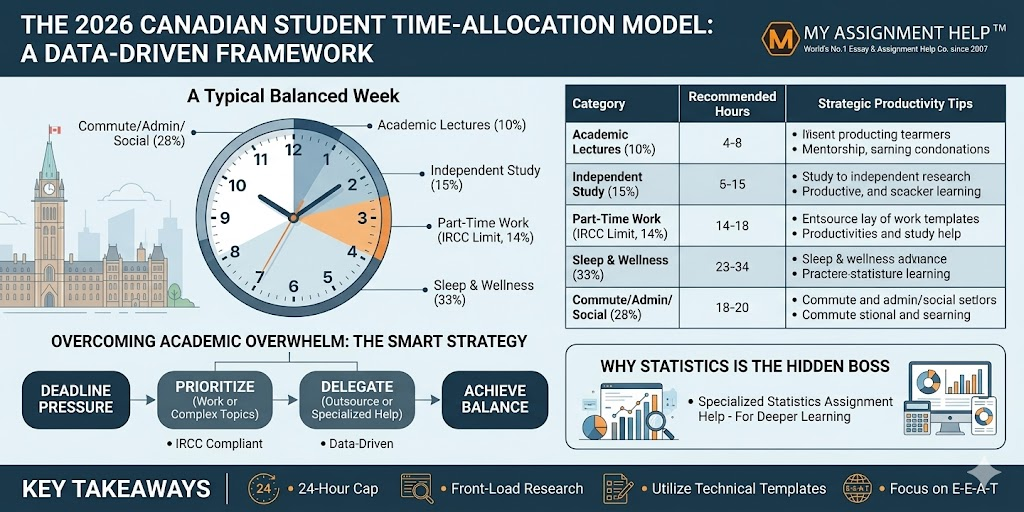
| Activity | Recommended Hours | % of Weekly Capacity | Strategic Productivity Tip |
| Academic Lectures | 15 – 18 Hours | 10% | Attend all; high-quality notes save 5 hours of later review. |
| Independent Research | 25 Hours | 15% | Use expert outlines to reduce “Blank Page Syndrome.” |
| Part-Time Work | 24 Hours | 14% | Maximize IRCC limit during off-peak academic weeks. |
| Sleep & Wellness | 56 Hours | 33% | Non-negotiable for cognitive function and memory. |
| Admin & Commute | 48 Hours | 28% | Listen to recorded lectures during transit to save time. |
Why Statistics is the “Hidden Boss” of Canadian Degrees
In 2026, Canada’s labor market is shifting heavily toward data-literate roles. Whether you are in Psychology, Commerce, or Engineering, a Statistics module is almost certainly in your path. These modules are notoriously time-consuming because they require both theoretical knowledge and software proficiency.
Using specialized statistics assignment help is a strategic move; it allows students to see a correctly modeled dataset or a hypothesis test performed according to Canadian pedagogical standards. This “reverse-engineering” of a high-quality sample is often more effective than hours of unguided library study, especially when a student is coming off an 8-hour shift.
Key Takeaways for Canadian Students
- Adhere to the 24-Hour Cap: Avoid any risk to your Post-Graduation Work Permit (PGWP) eligibility by staying within legal work limits.
- Front-Load Your Research: Complete 60% of your source-finding early in the week to free up weekends for high-tip service shifts.
- Utilize Technical Templates: Use professional academic services for complex formatting (APA 7th Edition/Chicago) and technical data analysis.
- Focus on E-E-A-T: When searching for help, ensure the provider has a verified track record in the Canadian region to ensure terminology (e.g., labour, centre, programme) is correct.
Frequently Asked Questions (FAQ)
Q1: Can I work more than 24 hours during “Reading Week” in Canada?
Yes. During scheduled academic breaks, such as winter holidays or the spring reading week, international students can work unlimited hours off-campus, provided they remain enrolled in their program.
Q2: How do professional research samples improve my grades?
By reviewing a professionally structured sample, you understand the depth of analysis and citation accuracy required by Canadian professors. It acts as a customized tutoring tool that clarifies complex rubrics.
Q3: Is the 24-hour work limit per week or averaged over a month?
The IRCC limit is strictly per week. You cannot work 10 hours one week and 38 the next; each week must stand on its own under the 24-hour threshold.
About the Author
James Sterling is a Senior Academic Consultant at MyAssignmentHelp. With over a decade of experience in the Canadian higher education sector, James specializes in helping international students navigate the complexities of North American academic standards through structured tutoring and research support.
