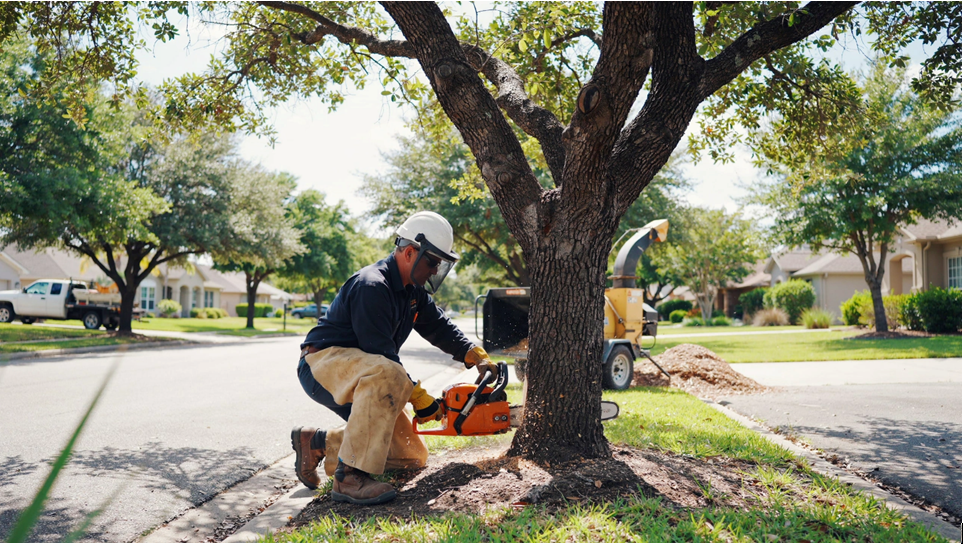
Arborist training is the combination of hands-on skill-building and formal certification that prepares someone to safely climb, prune, diagnose, and remove trees for a living. Most people start as a ground worker with little more than a basic chainsaw course, then build toward recognised credentials such as the ISA Certified Arborist designation in the US, NPTC units in the UK, or a Certificate III in Arboriculture in Australia, usually over two to five years of paid field experience. There is no single class that makes you an arborist. It is closer to a trade apprenticeship than a weekend workshop, and understanding that early will save you a lot of wasted time and money.
That is the short version. The rest of this guide breaks down what the training involves, what it costs, how long it realistically takes, and where the career can go from there. Many approved training providers, including Brampton Valley Training in Northamptonshire, deliver exactly this kind of structured pathway for people starting out in the UK.
What Does an Arborist Actually Do?
An arborist is a tree care professional trained in the biology, structure, and maintenance of trees, and the job goes well beyond cutting branches. This is where a lot of confusion starts, because the terms “arborist,” “tree surgeon,” and “tree removal contractor” get used interchangeably in everyday conversation, even though they do not mean the same thing within the industry.
A general tree removal contractor might know how to fell a tree and haul it away. An arborist is trained to look at that same tree and assess whether it needs to come down at all, whether it can be saved with pruning or cabling, and what is actually causing the dieback in the crown. In the UK, “tree surgeon” is used as a rough equivalent of “arborist.” In the US, the two terms sometimes separate by certification status. Either way, the deeper skill set is the same: biology first, chainsaw second.
The day-to-day reality is physical, and it is unglamorous a lot of the time.
- You work outside in heat, cold, and rain.
- You drag brush and feed a chipper before you ever touch a climbing rope.
- You spend real time on equipment maintenance and site clean-up.
- You follow strict safety procedures on every single job, without exception.
Trainees who go in expecting only the exciting parts of the job, such as climbing sixty feet up a canopy, tend to burn out fast once they realise how much of it is groundwork and repetitive labour. That is not a criticism of the trade. It is simply the part nobody puts in the brochure.
The Core Skill Areas Every Arborist Must Learn
Formal arborist training is built around a handful of skill categories, and every reputable programme touches all of them in some form, whether it is a two-week certificate course or a multi-year apprenticeship.
1. Tree Biology and Health Diagnosis
Knowing tree biology as a working skill means being able to look at a tree and read its condition the way a mechanic reads an engine. This includes:
- Structural defect recognition, such as cracks, cavities, included bark, and root plate lifting.
- Pest and disease identification, including the early visual signs of common tree diseases.
- Species-specific growth knowledge, since different trees respond differently to pruning cuts.
This is genuinely the point where “arborist” separates from “tree cutter” as a professional identity. Anyone can run a chainsaw with enough practice. Diagnosing whether a tree is a structural hazard or perfectly healthy takes real training, and it is the skill area weighted most heavily on professional certification exams.
2. Safety Systems and Personal Protective Equipment (PPE)
Tree work training treats PPE as a complete system, not a shopping list. A properly equipped climber or ground worker typically has:
- A rated helmet with integrated ear defenders and a mesh or full face shield.
- Chainsaw-rated trousers or chaps.
- Cut-resistant gloves.
- Boots built to the relevant chainsaw safety standard.
Climbers also learn harness inspection routines before every single use, clear drop-zone communication with the ground crew, and the two-person rule that is standard on most professional teams, meaning nobody climbs alone. In the US, this ties back to OSHA regulations and the ANSI Z133 safety standard. In the UK, it falls under the Health and Safety Executive and the Provision and Use of Work Equipment Regulations. In Australia and New Zealand, it sits under state-based WorkSafe rules. None of this is bureaucratic box-ticking. Tree work carries one of the highest fatality rates of any civilian occupation, and the safety training exists because the hazards are genuinely serious.
3. Chainsaw Operation and Maintenance
There is a meaningful difference between a ground saw and a top-handle climbing saw, and trainees learn both separately because each is used in a completely different posture and risk context. Ground-level training typically covers:
- Chain sharpening and correct tensioning.
- Bar oil checks and general saw maintenance.
- Kickback prevention and safe body positioning.
- Safe felling and cross-cutting technique.
Trainees are tested on maintenance just as heavily as on cutting, because a poorly maintained saw is one of the more common causes of on-the-job injury. UK-based programmes such as the Level 2 Certificate of Competence in Chainsaw Maintenance and Cross-Cutting offered through providers like Brampton Valley Training are built specifically around this foundation, working closely with HSE guidance to keep the syllabus aligned with current safe working practice.
4. Rigging and Rope Work
Rigging is a separate skill from climbing, and it is one of the more technical parts of the training that rarely gets explained properly outside the industry. It is the system of ropes, friction devices, and rigging points used to lower cut limbs and sections of trunk in a controlled way, so they do not crash through a fence, a roof, or a person standing below. Trainees learn basic load awareness and friction management, because a badly rigged piece can generate enough force to injure or kill someone on the ground crew, not just the climber.
5. Climbing Technique
Modern climbing training generally splits into two systems:
- Single Rope Technique (SRT), where the climber ascends a fixed line anchored at the top of the tree.
- Moving Rope System (MRS), the traditional doubled-rope technique that moves with the climber through the canopy.
These are usually taught and certified as separate units from ground-level chainsaw work. Climbing certification tends to be the single biggest factor separating entry-level pay from experienced-climber pay on most crews.
6. Equipment Operation
Beyond the saw and the rope, trainees are introduced to wood chippers, stump grinders, and, on larger crews, aerial lifts and sometimes cranes for big removals. It is worth knowing that heavy equipment such as aerial lifts and cranes often requires separate manufacturer-specific or state-issued operator licensing on top of general arborist training. “Trained” and “licensed to operate” are not always the same thing.
Certifications and Qualifications: Why They Differ by Country
Training and certification are not the same thing, and this is where a lot of guides oversimplify. Training teaches you the skill. Certification is a third party formally verifying that you have it, and the certifying bodies differ depending on where you live.
United States
- The benchmark credential is the ISA Certified Arborist, issued by the International Society of Arboriculture.
- Applicants generally need around three years of full-time, documented field experience, or a relevant degree paired with reduced experience.
- One year of qualifying experience is counted as approximately 1,795 hours worked, according to ISA’s own certification guidance.
- The exam itself is 200 multiple-choice questions across ten domains, with a passing score around 76 percent.
- Total first-attempt exam fees run a few hundred dollars depending on ISA membership status.
United Kingdom
- The system runs through NPTC and City & Guilds.
- Most entry-level tree work starts with CS30 (chainsaw maintenance and cross-cutting) and CS31 (felling small trees), usually delivered over two to five days plus a separate practical assessment.
- Climbers then progress to CS38 (tree climbing and aerial rescue) and CS39 (using a chainsaw from a rope and harness).
- These certificates do not technically expire, but the Health and Safety Executive recommends refresher training every three to five years.
- Entry-level roles with the basic ground tickets typically start in the low-to-mid twenty-thousand-pound range annually, with experienced climbers holding the full unit set earning considerably more.
Australia and New Zealand
- The standard qualification is the Certificate III in Arboriculture, sitting under the Australian Qualifications Framework.
- It usually takes twelve to twenty-four months through a registered training organisation, with no formal entry requirements.
- It covers both ground-based and climbing specialisations, and is commonly delivered as an apprenticeship.
- Consulting-level work typically requires progressing to the Diploma of Arboriculture, an AQF Level 5 qualification.
| Region | Core Certifying Body | Key Entry Credentials | Typical Requirement |
| United States | International Society of Arboriculture (ISA) | ISA Certified Arborist, OSHA 10/30 | About 3 years documented field experience, or degree plus experience, then a 200-question exam |
| United Kingdom | NPTC / City & Guilds | CS30, CS31 (ground), CS38, CS39 (climbing) | Short practical courses plus independent assessment, no minimum prior experience |
| Australia / NZ | Australian Qualifications Framework | Certificate III in Arboriculture | 12 to 24 months, no formal entry requirements, often run as an apprenticeship |
Arborist Training in Northamptonshire: A UK Example
For readers based in the UK, it helps to see what this looks like in practice at a regional level. Arborist training in Northamptonshire typically follows the NPTC and City & Guilds pathway described above, starting with ground-based chainsaw units and progressing through to full aerial and rigging qualifications. Providers such as Brampton Valley Training, based in South Northamptonshire, are approved Lantra Awards and City & Guilds (NPTC) centres, offering the full course progression from entry-level chainsaw tickets through to aerial rigging and utility arboriculture, all in one location. This kind of regional, industry-recognised training centre is a fairly accurate picture of how most UK arborists actually get started, rather than through a university degree.
The practical takeaway across all three regions: check with your own country’s or state’s recognised certifying body before paying for any course. Training that is not tied to a recognised credential in your region can be a waste of money, even if it teaches real skills, because employers and insurers usually ask for the specific local certificate, not just proof that you attended a class.
How Long Does Arborist Training Actually Take, and What Does It Cost?
This is the part almost nobody answers directly, and the honest answer depends heavily on which stage of training you mean.
Getting started as a ground worker requires little to no formal training up front. Most crews will bring someone on with basic safety orientation and teach chipper and brush-dragging duties on the job within days or weeks.
Individual entry-level certificate courses, such as a basic chainsaw ticket, typically involve:
- One to two weeks of instruction, plus a separate assessment day.
- A cost ranging from a couple of hundred to around a thousand pounds or dollars, depending on the provider and region.
Reaching a full professional credential is a different timeline entirely, because it is gated by experience, not just coursework.
- In the US, most sources estimate three to five years from entering the field to earning the ISA Certified Arborist credential, since the three years of documented experience is a hard requirement.
- Most candidates then spend a further two to four months studying before sitting the exam.
- In Australia, the Certificate III path runs twelve to twenty-four months as a structured programme, sometimes stretching to thirty-six months depending on the chosen specialisation.
- In the UK, the individual NPTC units can be completed relatively quickly, but building the full ground-to-climbing qualification set alongside paid field experience typically takes a similar two to three year window.
Cost adds up beyond course fees, too. Climbing gear, if you are expected to supply your own saddle, ropes, helmet, and PPE rather than using employer-issued kit, can easily run into four figures. Some employers cover certification costs and gear for staff they intend to keep long-term. Others expect newer workers to arrive at least partially equipped. It is worth asking directly during the hiring process rather than assuming either way.
Is Arborist Training Right for You? The Physical and Personality Reality
Nobody talks about this part enough, but it matters as much as the technical skills. Tree work rewards a specific physical and personality profile, and being honest about fit early saves people from an expensive and demoralising false start.
Physical demands typically include:
- Comfort working at real height for extended periods.
- Decent grip and upper-body strength for climbing and rigging.
- Tolerance for extreme heat and cold, since tree work does not pause for weather the way office work does.
- General cardiovascular fitness for a physically demanding, full working day.
A genuine fear of heights is not something that reliably fades with time in the canopy. For some people it does, for others it is a hard stop, and it is better to find that out on a supervised low-height climb early in training rather than after investing in a full certificate course.
Personality traits that tend to fit well include:
- Comfort with routine, managed risk, rather than anxiety or recklessness at either extreme.
- Genuine enjoyment of repetitive physical work broken up by problem-solving moments.
- Strong, fast communication skills under time pressure.
- A team-first mindset, since climbing crews operate on a two-person minimum for a reason and this work is rarely solo.
The injury risk in this trade is well documented and real, which is exactly why the safety training is not optional or symbolic. It is also worth noting that the industry, historically male-dominated, has seen a steady increase in women entering climbing and ground roles over the past decade, broadening who a “typical” arborist looks like.
Career Progression: Where Arborist Training Can Actually Lead
Most articles on this topic stop at “get a job with a tree crew.” That is the starting line, not the destination.
- Ground Worker. The entry point for almost everyone. Feeding the chipper, dragging brush, and learning basic site safety and equipment handling. It is unglamorous, but it is also where crews evaluate whether someone has the reliability and physical fit to justify further training.
- Climbing Arborist or Tree Surgeon. Where the technical climbing, rigging, and pruning skills get used daily. It is the highest physical demand role and often the highest field-level pay, since climbing certification is the main differentiator crews pay for.
- Utility or Line Clearance Arborist. A specialised niche working near power lines, requiring additional electrical hazard training on top of standard climbing certification. It tends to offer steadier, more predictable year-round work than storm-response or residential tree care, since utility vegetation management is a contracted, ongoing need rather than seasonal demand.
- Consulting Arborist or Tree Risk Assessor. A hybrid desk-and-field role built around the ISA Tree Risk Assessment Qualification (TRAQ) or an equivalent regional credential. This work involves formal risk assessment, written reports, and sometimes expert witness testimony in legal or insurance disputes. It generally involves far less climbing than the earlier stages, which makes it an appealing long-term path for climbers whose bodies are starting to feel the wear of years in the canopy.
- Plant Health Care Specialist. Focused on diagnosis and treatment, including pest and disease management and soil health. This usually requires a separate state or regional pesticide applicator licence layered on top of arborist certification.
- Independent Tree Care Business Owner. The natural next step for a lot of experienced climbers. It comes with its own learning curve around liability insurance, equipment investment, and client management that has nothing to do with tree biology, but it is a common and realistic endpoint for people who have built up a decade or so of field credibility.
How to Start: A Realistic Step-by-Step Path
- Research your region’s recognised certifying body first. Check what your country or state actually requires and recognises, such as ISA, NPTC, or AQF, before spending money on any course.
- Start with a basic chainsaw and safety course, even before committing to climbing. It is the cheapest entry point and gives you a real sense of whether the physical work suits you.
- Get on with a local tree crew as a ground worker. This is how most people in the industry actually got their start, and it lets you build paid hours while testing fit.
- Pursue climbing and aerial rescue certification once your ground experience and comfort level are solid, not before.
- Work toward a recognised professional credential, using your logged field hours, whether that is the ISA Certified Arborist exam, a full set of NPTC climbing units, or a completed Certificate III.
- Specialise once your core competency is established by choosing a direction such as utility work, consulting, or plant health care, based on what you enjoyed most during your early years on a crew.
Frequently Asked Questions
How do I become an arborist in the UK?
Most UK arborists start with a ground-based NPTC chainsaw qualification (CS30 and CS31), then progress to climbing and aerial rescue units (CS38 and CS39) through an approved training centre while working on a crew.
What qualifications do I need to be an arborist?
At minimum, a recognised chainsaw certificate such as NPTC CS30/CS31 in the UK or the equivalent local ground-level ticket. Climbing, aerial rescue, and further specialist units are added as your experience grows.
How long does it take to become a qualified arborist?
Typically two to five years from entering the field to reaching a full professional credential, since most systems require documented experience alongside coursework, not just class attendance.
Is being an arborist a good career?
It can be, with genuine outdoor variety and a clear skills-based progression, but it is also physically demanding and carries a higher-than-average injury risk, so it suits people who are comfortable with managed physical risk.
Do arborists need a degree?
No. Most professional credentials, including the ISA Certified Arborist and UK NPTC units, are earned through documented field experience and practical assessment rather than a university degree.
Is arborist training dangerous?
The training itself is designed to reduce risk, but the underlying trade is genuinely one of the more hazardous civilian occupations. This is exactly why the safety component of training is treated as essential rather than a formality.
Conclusion
Arborist training is not a single course you complete and walk away qualified. It is a layered process that starts with basic safety and chainsaw skills, builds through supervised field hours, and eventually leads to a recognised professional credential, with real branching points along the way toward climbing, consulting, utility work, or running your own business. If you are thinking about starting, the honest first step is not researching the ISA exam or booking a climbing course. It is deciding whether you want to begin with formal coursework, such as the courses run by providers like Brampton Valley Training, or get hands-on as a ground worker first, based on where you live and how your body handles physical, outdoor work. Everything else in this guide builds from that one decision.
